

Table of Contents
ToggleSending large-format documents without folding is a common requirement across many industries in the UK. Architects, designers, printers, educators, artists, and businesses frequently deal with oversized paper that must arrive flat, clean, and undamaged. In these cases, postal tubes are not just a convenience but a necessity. Among the available options, A1 postal tube size is one of the most widely used and searched formats.
While the term “A1” suggests a standard, postal tubes are not identical across suppliers. Differences in length tolerance, diameter, wall thickness, material, and weight can significantly affect whether an item arrives safely or incurs avoidable shipping issues. Many buyers discover too late that a tube labelled “A1” does not always suit their specific item.
Understanding the A1 Paper Format
Before choosing a tube, it is essential to understand what “A1” actually means. A1 is part of the ISO 216 paper sizing system used throughout the UK and Europe. It follows a fixed ratio where each size is half the area of the previous one.
An A1 sheet measures:
- 841 mm × 594 mm
- 84.1 cm × 59.4 cm
- 33.1 inches × 23.4 inches
When rolled for posting, the 841 mm side becomes the controlling dimension, as this determines the minimum internal length required for the tube. This is why A1 postal tubes are longer than 841 mm; they must allow room for safe insertion and end closures without compressing the edges.
Why A1 Postal Tube Size Matters More Than It Appears
At a glance, selecting a postal tube may seem straightforward. However, incorrect sizing leads to several common problems:
- Creased or crushed document edges
- Excessive curl memory in prints
- Courier surcharges due to oversize parcels
- Rejected deliveries based on length limits
- Increased postage costs from unnecessary diameter
An A1 postal tube must strike a balance between internal capacity, protection level, and external parcel size. Too small, and the contents suffer. Too large, and shipping efficiency is lost.
Standard A1 Postal Tube Dimensions Explained
Postal tubes are defined primarily by length and diameter, not by width and height.
Typical A1 Postal Tube Measurements
| Measurement Type | Size |
|---|---|
| Internal Length | 850–860 mm |
| External Length | 870–880 mm |
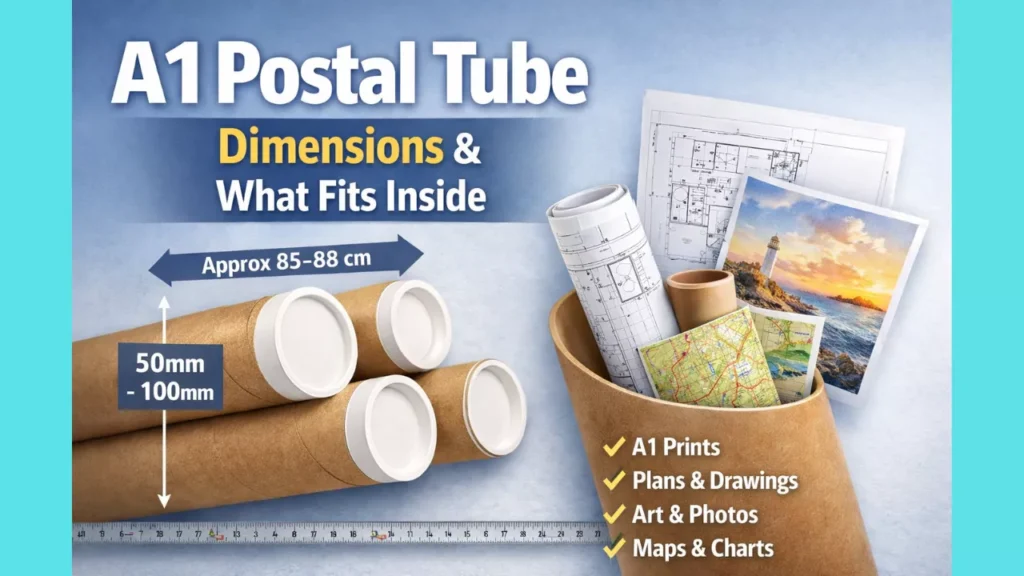
| Length (cm) | 85–88 cm |
| Length (inches) | 33.5–34.6 in |
| Common Diameters | 50 mm, 63 mm, 76 mm, 100 mm |
The extra length beyond 841 mm accounts for:
Internal vs External Length: A Critical Distinction
One of the most frequent causes of sizing errors is confusion between internal and external measurements.
- Internal length determines whether your document physically fits
- External length determines how couriers classify the parcel
For example:
- An A1 tube with an internal length of 860 mm may have an external length of 880 mm once caps are fitted
- Couriers base pricing and acceptance on the external measurement
If you are close to a courier’s maximum allowed length, this distinction becomes essential.
Diameter Options for A1 Postal Tubes
Diameter has a greater impact on usability than many buyers realise. It controls how tightly an item must be rolled and how well it resists damage.
Common A1 Postal Tube Diameters
| Diameter | Typical Use | Protection Level |
|---|---|---|
| 50 mm | Single posters | Basic |
| 63 mm | Standard prints, plans | Moderate |
| 76 mm | Artwork, coated paper | High |
| 100 mm | Multiple sheets, canvas | Very high |
Smaller diameters reduce parcel volume but increase stress on the document. Larger diameters allow gentler rolling and better protection but increase shipping size.
How Diameter Affects Document Condition
A tightly rolled document may appear undamaged on arrival but suffer from:
- Persistent curl
- Ink cracking on heavy prints
- Difficulty laying flat for framing or scanning
This is particularly relevant for:
- Glossy posters
- Fine art prints
- Photographic paper
- Technical drawings requiring precision
Choosing a slightly larger diameter often improves the recipient’s experience significantly.
Weight of an A1 Postal Tube
Weight affects both manual handling and shipping cost.
Approximate Empty Weights (Cardboard Tubes)
| Diameter | Average Weight |
|---|---|
| 50 mm | 250–300 g |
| 63 mm | 300–350 g |
| 76 mm | 400–450 g |
| 100 mm | 550–700 g |
These figures vary based on wall thickness and material grade. When loaded, the final parcel weight depends on:
- Paper thickness
- Quantity of sheets
- Additional protective sleeves
Heavier tubes are not automatically better; strength should match the item being sent.
Materials Used in A1 Postal Tubes
Spiral-Wound Cardboard Tubes
Spiral-wound tubes are manufactured by wrapping layers of kraft paper around a mandrel, creating a strong cylindrical structure. This method provides excellent resistance to crushing while keeping weight relatively low.
This form of paper tube construction is widely used in cardboard tube packaging for posters, plans, and prints across the UK. It offers a reliable balance between protection, cost, and recyclability, making it the most common material choice for A1 postal tubes.
Heavy-Duty Kraft Tubes
Heavy-duty versions use thicker paper layers, increasing rigidity. These are suitable for:
- Artwork
- Client-facing deliveries
- High-value prints
- Repeated handling
Plastic Postal Tubes
Plastic tubes offer water resistance and reusability but are heavier and less environmentally aligned with UK packaging trends. They are typically reserved for specialist reuse cases rather than general postal use.
Material Comparison
| Material | Strength | Weight | Sustainability | Typical Application |
|---|---|---|---|---|
| Standard Cardboard | Medium | Light | High | Posters |
| Heavy-Duty Kraft | High | Medium | High | Art prints |
| Plastic | Very high | Heavy | Low | Reusable transport |
What Fits Inside an A1 Postal Tube?
A1 postal tubes are designed for rolled materials, not rigid boards.
Common items include:
- A1 posters
- Architectural drawings
- Engineering plans
- Art and photography prints
- Educational charts
- Maps
These items are usually rolled and shipped using rigid tubes, often supplied as paper tube or cardboard tube packaging depending on the protection level required. Thicker stocks and multiple sheets increase roll diameter quickly, which must be accounted for when choosing tube size.
Matching A1 Tube Size to Item Type
| Item Type | Recommended Diameter | Reason |
|---|---|---|
| Single poster | 50–63 mm | Cost-efficient |
| Multiple posters | 63–76 mm | Reduced stress |
| Art prints | 76–100 mm | Lower curl |
| Canvas prints | 100 mm | Shape retention |
| Technical drawings | 63–76 mm | Easier re-flattening |
Buyer Intent: How Different Users Choose A1 Postal Tubes
Cost-Focused Senders
Often sending promotional posters or internal documents. Preference is given to smaller diameters and lighter tubes to minimise postage.
Protection-Focused Senders
Sending artwork, photography, or client work. Larger diameters and thicker walls are prioritised over cost.
Business and Volume Users
Standardise tube sizes to optimise storage, packing speed, and courier compliance while maintaining acceptable protection. Understanding buyer intent helps avoid mismatched purchases.
Courier and Shipping Considerations in the UK
UK couriers often apply limits based on:
- Maximum length
- Combined length and girth
- Weight thresholds
A1 tubes typically fall within standard limits, but wider diameters increase girth and may trigger surcharges. Always check external measurements when shipping in bulk.
Storage and Handling of A1 Postal Tubes
Proper storage ensures tubes maintain their shape and strength.
- Store vertically where possible
- Avoid prolonged pressure from heavy objects
- Keep away from damp conditions
- Keep end caps fitted
Well-made paper tube packaging maintains its round shape better over time, particularly when reused as a paper tube for prints or documents.
Measuring Correctly Before Buying
- Measure internal length if contents are rigid
- Consider rolled thickness before selecting diameter
- Add clearance for end caps
- Account for protective sleeves or interleaving
Precision avoids last-minute packing issues.
Common Mistakes to Avoid
- Assuming all A1 tubes are the same
- Choosing diameter purely on price
- Ignoring wall thickness
- Over-rolling coated or heavy paper
- Confusing internal and external measurements
Final Thoughts
An A1 postal tube is more than a simple container. While the A1 format defines the minimum length requirement, diameter, material choice, wall thickness, and internal clearance determine whether contents arrive undamaged.
By understanding postal tube size in mm, cm, and inches, selecting diameter based on real item characteristics, and choosing materials appropriate to the level of protection needed, senders can avoid damage, control shipping costs, and ensure professional delivery. Correct sizing is not an afterthought—it is the foundation of safe transport.
Frequently Asked Questions
What is the standard A1 postal tube length?
Most have an internal length of 850–860 mm.
Is diameter more important than length?
Length ensures fit; diameter determines protection.
Can multiple A1 sheets fit in one tube?
Yes, but diameter should increase accordingly.
Are A1 postal tubes accepted by UK couriers?
Yes, provided external dimensions meet courier limits.
Do end caps affect usable space?
Yes, caps reduce internal length slightly.