


There’s a moment every delivery driver knows well — the stack of pizza boxes sliding on the back seat, the slight dread when handing over a box that feels suspiciously soft. For the customer opening it at home, the outcome is obvious: a pie that arrived intact versus one with a collapsed lid pressed into the cheese. That difference often comes down to a decision most restaurant operators never consciously make — which corrugated flute to use.
Pizza box board isn’t just “cardboard.” It’s an engineered structure, and the flute profile running through its middle layer determines how the box performs under real delivery conditions: stacking weight, heat retention, moisture absorption, and the brutal last-mile jostles between your kitchen and someone’s front door.
What Corrugated Flute Actually Is (and Why It Matters More Than GSM)
A corrugated board has three layers: two flat liner sheets with a wave-shaped medium — the flute — sandwiched between them. The flute’s shape and height define the board’s entire mechanical personality.
Most buyers focus on the liner’s GSM (grams per square metre) weight when specifying boxes, assuming heavier paper means a stronger box. That’s partially true, but the flute profile governs something more critical: the column crush strength, which is what keeps the box from collapsing when three others are stacked on top of it in a delivery bag. For pizza specifically, three flute profiles dominate the market: E-flute, B-flute, and C-flute. Each has a distinct physical profile, and each creates a different set of trade-offs.
E-Flute: The Sleek Option With Hidden Weaknesses
E-flute has approximately 90 flutes per linear foot, with a board thickness of around 1.6mm. It’s the thinnest of the three and was originally developed for retail packaging where print quality mattered more than structural strength.
Where E-flute works for pizza: Smaller, lighter pizzas — personal-sized pies under 10 inches — can work well in E-flute boxes, particularly for dine-in or counter collection where the box isn’t being stacked or transported in a bag. The thin board also means a tighter, more precise box construction with sharper print detail if branding is a priority.
Where it fails: Stack three E-flute pizza boxes and you’ll feel the difference immediately. The shorter flute height means significantly lower edge crush test (ECT) values compared to B or C flute at equivalent liner weights. In a delivery bag with two or three boxes stacked, the bottom box absorbs compressive force that E-flute board simply isn’t designed to handle over the 30–45 minutes of a typical delivery run.
E-flute also offers less thermal insulation because the thinner air gap between liners provides less of a barrier against heat loss. For a 12-inch pizza needing to stay above 60°C at the door, that matters.
B-Flute: The Delivery Workhorse
B-flute runs around 47 flutes per linear foot with a board thickness of approximately 3mm. This is the profile you’ll find in the majority of commercially produced pizza boxes globally, and for good reason.
The thicker flute profile provides substantially better column crush resistance than E-flute, meaning stacked boxes hold their shape. More importantly for pizza, the deeper air cavity within the board acts as a genuine thermal buffer — slowing heat dissipation from the bottom of the box, which is typically the first surface to lose temperature.
The sogginess problem and how B-flute helps: Pizza box sogginess has two causes. The first is steam. A hot pizza releases moisture as steam, which condenses on the inside of the lid and rains back down onto the crust — this is why many pizza packaging boxes have ventilation holes. The second is direct contact with wet packaging. B-flute’s structural rigidity means the box maintains its shape throughout delivery, keeping the base flat and preventing the crust from sitting in pooled condensation that can collect in a warped bottom.
Practical application: B-flute is the correct default choice for most independent pizzerias operating at 50–300 covers per day and delivering within a 5–10km radius. The balance between structural performance, thermal retention, and cost per unit makes it the sensible specification for the majority of real-world delivery scenarios.
C-Flute: When Load-Bearing Capacity Is Non-Negotiable
C-flute sits at around 39 flutes per linear foot with a board thickness of approximately 4mm. It’s less common in retail pizza packaging but appears in high-volume commercial operations and catering contexts where boxes are stacked 6–10 deep in transit. The thicker profile means significantly higher ECT ratings — often 20–30% stronger in edge crush tests compared to equivalent B-flute at the same liner specification. For a caterer delivering 40 boxes of pizza to a corporate event, or a ghost kitchen consolidating large orders into a single delivery run, C-flute’s stacking strength becomes operationally relevant.
The trade-offs are real though. C-flute board is heavier, which adds material cost and increases the dead weight each delivery driver handles. The board is also stiffer, which can make the box slightly harder to fold cleanly at high speed on a production line — a legitimate concern for high-throughput operations. On moisture: C-flute’s thicker board means the outer liner is physically further from the heat source, and the deeper flute cavity holds slightly more air. In theory, this improves insulation. In practice, the difference over a 30-minute delivery versus B-flute is marginal — not a primary reason to upgrade to C-flute unless stacking performance is the actual problem being solved.
Side-by-Side Comparison: Which Flute for Which Operation
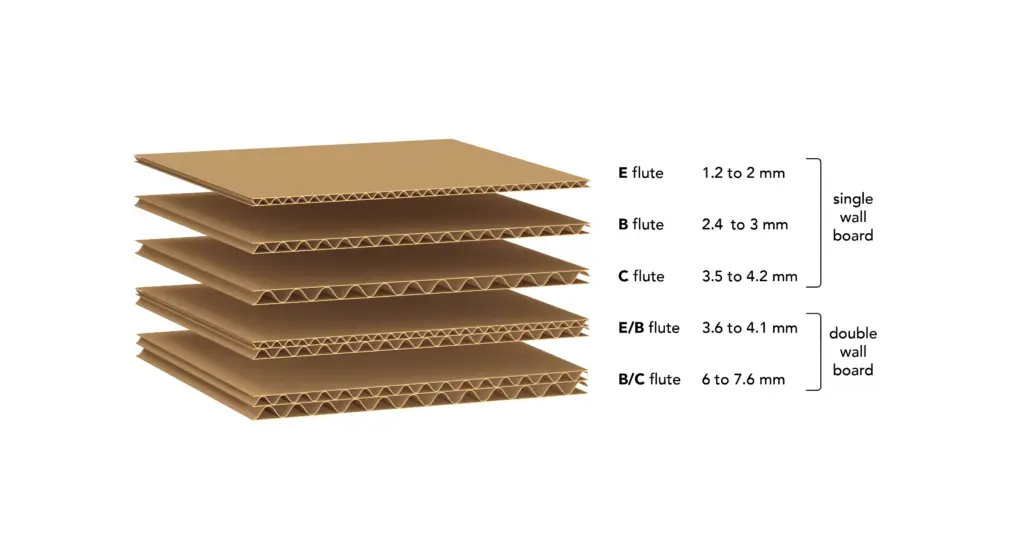
| E-Flute | B-Flute | C-Flute | |
|---|---|---|---|
| Board thickness | ~1.6mm | ~3mm | ~4mm |
| Flutes per linear ft | ~90 | ~47 | ~39 |
| Crush resistance | Low | Medium–High | High |
| Thermal insulation | Low | Good | Good–Excellent |
| Moisture resistance | Moderate | Good | Good |
| Print quality | Excellent | Good | Moderate |
| Best for | Counter collection, small pies | Most delivery scenarios | High-volume stacking, catering |
| Cost per unit | Lowest | Mid | Highest |
Real-World Scenarios: Matching Flute to Restaurant Scale

Small independent pizzeria, 40–80 covers per night, local delivery: B-flute with a 125gsm outer liner and 112gsm inner liner is the right call. You don’t need C-flute’s stacking power, and E-flute will let you down on a double-stack in a delivery bag during a Friday rush.
Fast-casual chain running a ghost kitchen, 200+ delivery orders per shift: B-flute remains appropriate for single orders. If dispatchers are consolidating 4–6 boxes per driver run, a C-flute specification for family-size pizza boxes (14-inch and above) is worth the cost difference — a collapsed bottom box on a £60 order costs more than the premium board.
Event caterer delivering bulk pizza for corporate functions: C-flute without question. Boxes stacked 8 high in transit create the kind of compressive load that will deform B-flute board before the van reaches its destination.
Premium sit-down restaurant offering takeaway: If brand presentation matters as much as delivery performance, consider a double-wall construction (B/C twin-wall) for large pizzas. It’s expensive, but for a restaurant where the box carries the brand, it signals quality before the lid is even opened.
One Detail Most Operators Overlook: Moisture Barrier Coatings
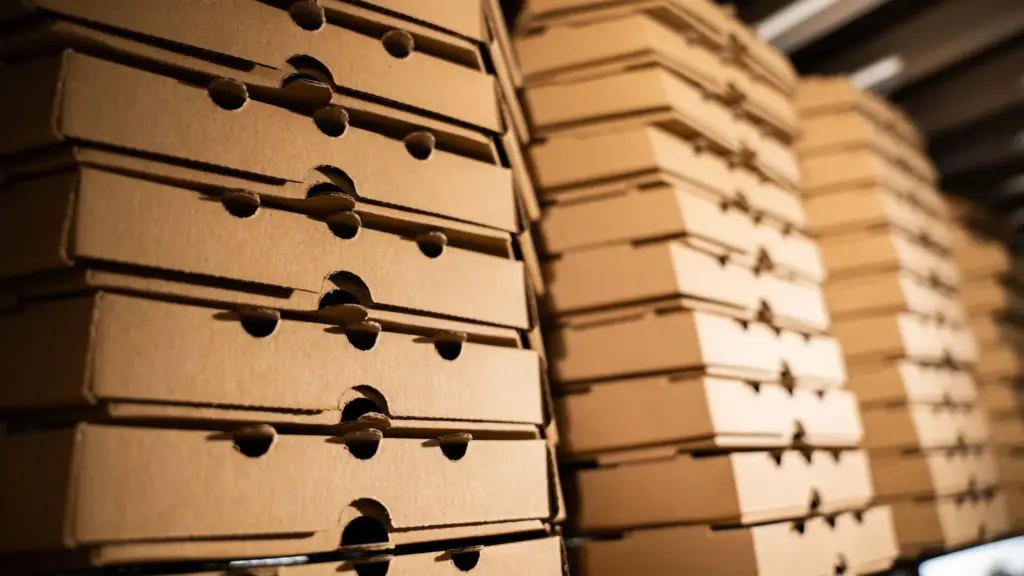
Flute selection alone doesn’t solve the moisture equation. A B-flute box with no moisture barrier coating will absorb grease through the base liner within 15–20 minutes of contact with a hot pizza. Most commercial takeaway pizza boxes include a clay-coated or poly-lined inner base for this reason. When specifying boxes, always confirm the inner liner treatment alongside the flute profile. A C-flute box without a moisture barrier will perform worse than a B-flute box with proper base coating — the flute profile and liner specification work together, not independently.
Making the Right Call
The honest answer for most operators: B-flute with a coated inner base liner covers the majority of delivery scenarios at a sensible cost. Upgrade to C-flute selectively — for large-format pizzas, catering volumes, or routes where multiple boxes are routinely stacked — rather than across your entire box range.
E-flute has its place in counter service, branding-forward packaging, and small formats where structural load isn’t a concern. But routing it into a delivery operation to save a few pence per box is a trade-off that tends to show up as complaints, not savings. The flute running through your pizza box is doing invisible work on every delivery. Choosing it deliberately is one of the easier wins available in an industry where the margins on getting delivery right are already thin enough.